Disclosure: this guide is written by the FEMUEY team, and we make some of the products mentioned below. Prices change often, so check the store before you buy.
The short answer
Learn the rules, then the basic checkmates, then simple tactics, and play real games from the first week. About twenty minutes a day is enough to make steady progress. Adults have an advantage here: you can practise on purpose and learn from your own mistakes.
You do not need to buy anything to start. Our beginner chess course has 78 free lessons that take you from naming the pieces to finishing a game on your own, on a phone or a laptop.
A step-by-step plan
- The rules (first week). How each piece moves, check and checkmate, castling, en passant and promotion. Then play your first full games, even if they are messy.
- Basic checkmates (week two). King and queen against king, and king and rook against king. Knowing these means a winning position stays winning.
- Safety first (weeks two to four). Before every move, ask what your opponent is threatening and which of your pieces are undefended. This one habit wins more games than any opening.
- Simple tactics (from week three). Forks, pins, skewers and discovered attacks. A few puzzles a day build the patterns. Our guide to puzzles and endgames has a routine.
- Opening principles (from week four). Control the centre, develop your knights and bishops, castle early. Learn one opening for each colour only when the principles feel natural; see how to practise openings on a real board.
- Play and review (always). Play slower games, then look back at each one and find the moment it turned.
How much time should you spend?
Short and regular beats long and occasional. Twenty minutes a day, five days a week, will take you further than a three-hour session once a month. A good split for each session: a lesson or a few puzzles, then a game.
Free lessons built for any age
Our free course has 78 lessons across four levels: learning the rules and playing on your own, spotting threats and calculating tactics, making plans, and building your own opening, calculation, endgame and review routine. Levels are set by what you can do, not by age, so an adult starting from zero uses it the same way as anyone else.
- About twenty minutes per lesson, in six short steps, with a short review the next day.
- A placement test if you already know a little: twelve rounds, a few minutes, and lessons you have clearly passed are marked as mastered.
- An AI teacher who walks you through the thinking rather than handing over the answer. There is a daily limit on questions.
- Real games against Maia, an engine trained on human games, with nine levels from 1100 to 1900 Elo.
The course has a playful theme, with each lesson framed as delivering a letter, but the chess is the same chess you will play anywhere. Start the free course.
Where to play your games
- Online: Lichess is free and has opponents at every level, any time of day.
- Against a computer: good for practice without pressure, and you can take moves back while you learn.
- Over the board: a local chess club or a friend. Playing with real pieces across a table is the most fun way to play, and the way many adults stick with chess.
Is an electronic board worth it for an adult beginner?
Not at the start. A phone or laptop is enough for the course. An electronic board makes sense once you want to play regularly with real pieces and no screen in front of you:
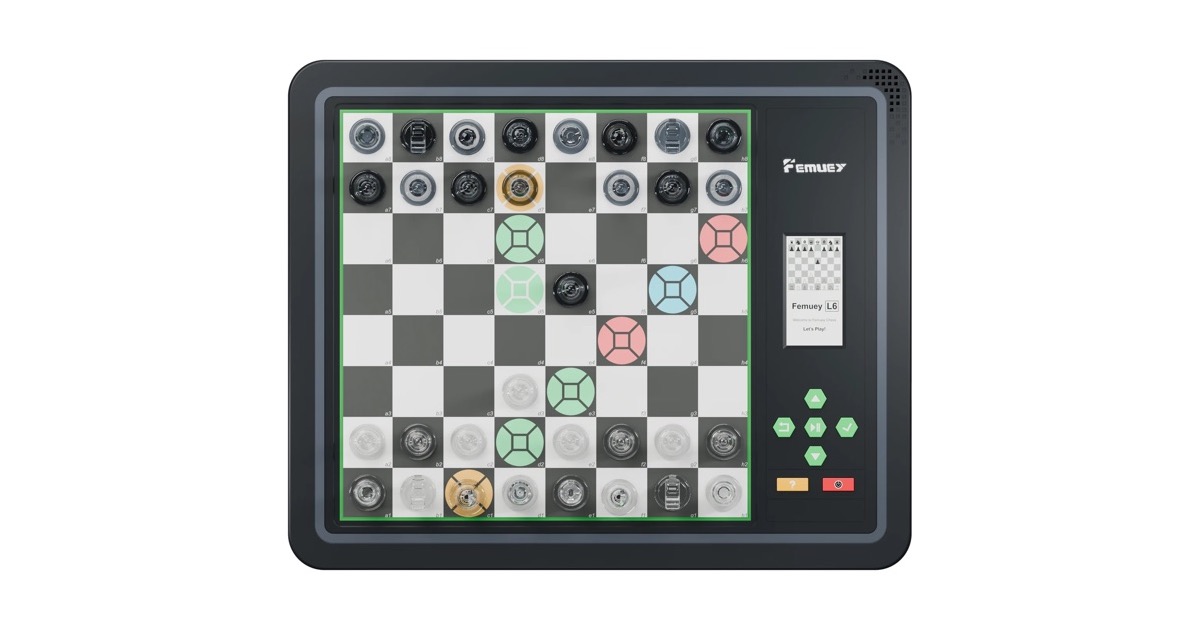
- FEMUEY L6 Pro ($208): a 2300 Elo engine on the board leaves plenty of room to grow, plus 1,000 puzzles, and Lichess games from the board over Wi-Fi, no phone needed.
- FEMUEY P6: a screen-free board with an 1800 Elo engine, 200 puzzles, and lights and voice guidance on every move.
- FEMUEY Y2 ($78): a handheld for puzzles and games on the commute, with 1,000 puzzles and Lichess over Wi-Fi.
Prices at the time of writing. For an honest look at who gets the most out of one, read are electronic chess boards worth it?
FAQ
Is it too late to learn chess as an adult?
No. Adults can learn chess at any age and often improve quickly, because they can practise deliberately and review their own games.
How long does it take an adult to learn chess?
Most people learn the rules in a few days. Playing a full game confidently takes a few weeks of regular practice; improving after that is a matter of tactics, endgames and reviewing your games.
Is the FEMUEY chess course free for adults?
Yes. All 78 lessons are free for everyone. Levels are set by what you can do, not by age. The AI teacher has a daily limit on questions.
Do I need a chess board to learn?
No. A phone or laptop is enough for the course. A real board helps once you want to play with physical pieces.
What warranty and returns come with FEMUEY boards?
Every FEMUEY board has a 1-year warranty. Hardware can be returned within 15 days of delivery, and in-stock orders ship worldwide within 72 hours of payment. See the FAQ for details.
Last updated: October 2026.
No comments yet
Be the first to share your insight