
Disclosure: this guide is written by the FEMUEY team, and we make some of the products mentioned below. Prices change often, so check the store before you buy.
The short answer
If you want to improve quickly, spend most of your practice time on tactics puzzles and a little on basic endgames. Solve a handful of puzzles every day, calculate each one fully before you move, and come back to the ones you missed. Then practise a few simple endgames until you can win them without thinking.
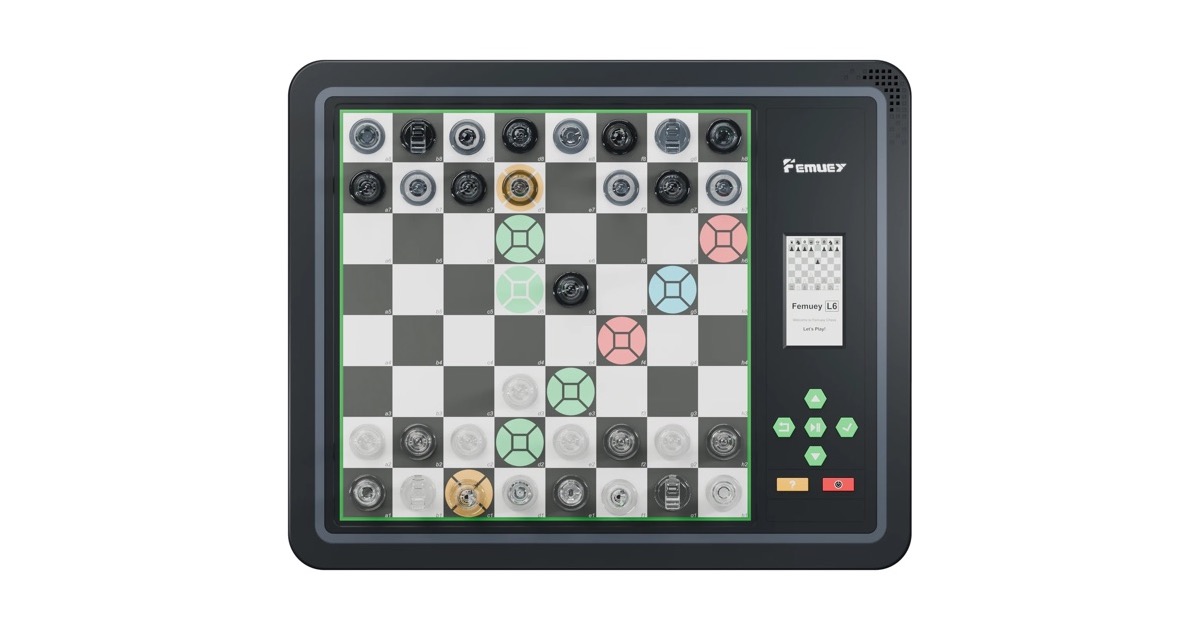
A real board helps both stick. On FEMUEY L6 Pro and FEMUEY Y2 there are 1,000 built-in puzzles, and FEMUEY P6 has 200. All three let you set up your own endgame positions to practise, with no phone or Wi-Fi needed.
Why puzzles and endgames?
- Tactics decide most beginner games. A fork, a pin or a piece left undefended usually matters more than which opening you played.
- Puzzles train pattern recognition. After you have seen a knight fork twenty times, you start to spot it in your own games.
- Endgames turn advantages into wins. Being a queen up is only worth something if you know how to checkmate.
Tactics to learn first
- Undefended pieces. Before every move, check what your opponent can capture, and what you can.
- Forks. One piece attacks two at once. Knights and queens are the usual culprits.
- Pins and skewers. A piece cannot move, or must move and expose something more valuable behind it.
- Discovered attacks. Moving one piece uncovers an attack by another.
- Back-rank mates. A king trapped behind its own pawns can be mated by a single rook or queen.
Endgames to learn first
- King and queen against king. Push the king to the edge, then mate. Watch out for stalemate.
- King and rook against king. Slower, but the same idea: box the king in, rank by rank.
- King and pawn against king. Learn when the pawn promotes and when it is a draw. Two ideas do most of the work: the opposition (kings facing each other with one square between) and the square of the pawn (whether the defending king can catch it).
- Later: basic rook endgames, such as the Lucena and Philidor positions, once the first three feel automatic.
A 20-minute daily routine
- Puzzles (10 minutes). Solve five to ten. Do not move until you have worked out the whole line, including your opponent’s best reply. If you miss one, set it aside and try it again tomorrow.
- Endgame (5 minutes). Set up one of the endgames above on the board and play it through until you win it cleanly.
- Look back (5 minutes). Take your last game and find the first moment a tactic was available, for you or for your opponent.
Practising on a real board
Puzzles on a phone are quick, but solving on a physical board is closer to how you see positions in a real game. With a normal set you need a book or a screen to give you the positions and check your answers. An electronic board does both:
- Built-in puzzles: 1,000 on L6 Pro and Y2, 200 on P6. They run on the device, so you can practise without Wi-Fi or a phone.
- Your own endgames: all three let you set up an endgame position and practise it.
- Room to try again: on L6 Pro and P6, hints and takebacks let you go back and try another idea instead of starting over.
- Then play a game: L6 Pro’s 2300 Elo engine and P6’s 1800 Elo engine run on the board, so you can test what you practised straight away.
Not sure which board fits? See our comparison page.
Find out what to practise
The fastest way to choose your next puzzles is to look at the mistakes you actually make. Our AI game review points out the turning points of a game and the kinds of mistakes you keep making. Games you sync from L6 Pro to the app can be reviewed too. If you are just starting out, the second level of our free 78-lesson course is about spotting threats and calculating tactics, and the fourth builds an endgame and review routine.
FAQ
How many chess puzzles should I do a day?
Five to ten, solved carefully, is plenty for most beginners. Calculating each one fully matters more than solving many quickly.
Should a beginner study endgames?
Yes, but only the basics at first: king and queen against king, king and rook against king, and king and pawn endings. They come up often and decide games.
How many puzzles do FEMUEY boards have?
FEMUEY L6 Pro and Y2 have 1,000 built-in puzzles each, and P6 has 200. All three also let you set up your own endgame positions.
Do I need Wi-Fi to use the puzzles on FEMUEY L6 Pro?
No. The puzzles, endgame practice and the 2300 Elo engine all run on the board without a connection.
What warranty and returns come with FEMUEY boards?
Every FEMUEY board has a 1-year warranty. Hardware can be returned within 15 days of delivery, and in-stock orders ship worldwide within 72 hours of payment. See the FAQ for details.
Last updated: October 2026.
No comments yet
Be the first to share your insight